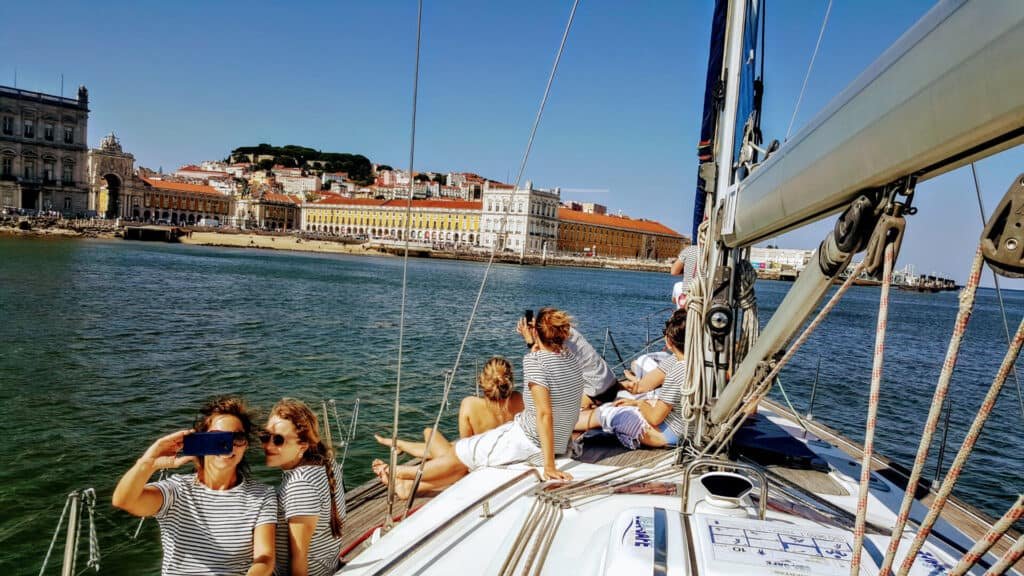


From the historic Belém Tower to the beautiful Bay of Cascais, the Lisbon region offers different settings for these competitions. The course and participation conditions depend on each race and the sailing conditions.
How does a sailing regatta work?
In a regatta, teams aim to complete the course in the shortest possible time while following the established rules. To do this, they need to adjust their sails and adapt their navigation to the wind’s direction and intensity.
However, changing winds create additional challenges, requiring attention and quick responses from the sailors. Naturally, the choice of course and the crew’s coordination also influence performance and the final result.
In these competitions, vessels are separated by classes and the number of crew members can also vary. It is suitable for all ages, whether you are experienced or just curious about the field.
Course, start, and finish
The regatta committee defines the course and race instructions, including the marks to be rounded, the starting procedures, and the finish line.
The courses may be marked with buoys. At the end of the races, an imaginary finish line is usually defined between a buoy and a small boat (from the regatta committee). After crossing the “line,” the judges sound a horn to signal the end of the sailboat’s race, recording the time achieved during the event.
In addition, the organization monitors weather conditions before and during the event, and may adjust or postpone the race when conditions require it. The rankings follow the regulations applicable to each class or division.


A brief history of regattas in Lisbon
The practice of water sports is part of Lisbon’s history. The Lisbon Naval Club, founded in 1892, is one of the institutions linked to its promotion and development. Even back then, water sports—especially regattas—were growing strongly in popularity.
Since then, they have become an important part of Lisbon’s maritime culture. Today, regattas are held regularly throughout the country and attract curious visitors from all over the world.
Our participation in the Plastimo Regatta 2024
The Tagus River continues to host sailing competitions with different types of boats and formats. In 2003, Plastimo organized the largest regatta ever held in Portugal, bringing together around 152 sailboats on the Tagus River and providing a stage for 1,500 participants.


In 2024, to celebrate 30 years of Plastimo’s representation in Portugal by Grupo Siroco, the historic regatta returned. This edition featured challenging courses and thrilling moments, with sailors from various parts of the world. The Lisbon Sight Sailing team gave it their all!
The challenge of a lack of wind
This participation showed how sailing depends on reading the conditions in the moment. The crew needs to adjust the sails, coordinate tasks, and adapt their decisions to the available wind.
On September 21st, the regatta—with more than 100 boats on the water—took place on the Tagus River on a day when the weather conditions initially didn’t look very promising. In other words, the wind wasn’t in our favor, or in this case, the lack of it. The absence of wind demanded skill and strategy from the participants to make the most of every gust and keep the boats moving.
A gathering among participants
After the competition, the awards ceremony took place at Tapada da Ajuda, bringing participants together for a moment of camaraderie.
For Lisbon Sight Sailing, taking part in the Plastimo Regatta was also an opportunity to share the experience of sailing and competing on the Tagus with other crews.


What connects a regatta to teamwork?
Just like in a company, a regatta requires setting goals, distributing tasks, communicating, and adapting decisions to external conditions. Coordination among crew members makes this activity relevant for groups looking to develop these skills together.
To learn about the benefits, preparation, and workings of a corporate activity, check out our guide: Organizing Regattas: A Boost for Team Building.